What’s inside the free kit
Eight pages, made for beginners and for writing by hand — big type, plenty of room, nothing to subscribe to. Here is every page:
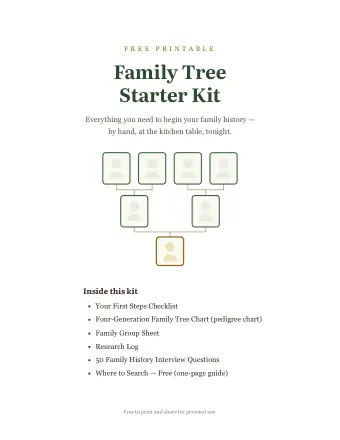 1. CoverWhat’s inside, at a glance
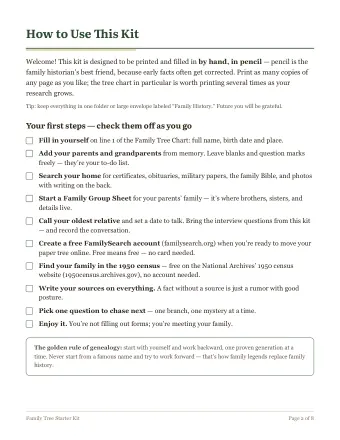 2. First-steps checklistTen small steps, in the order that works
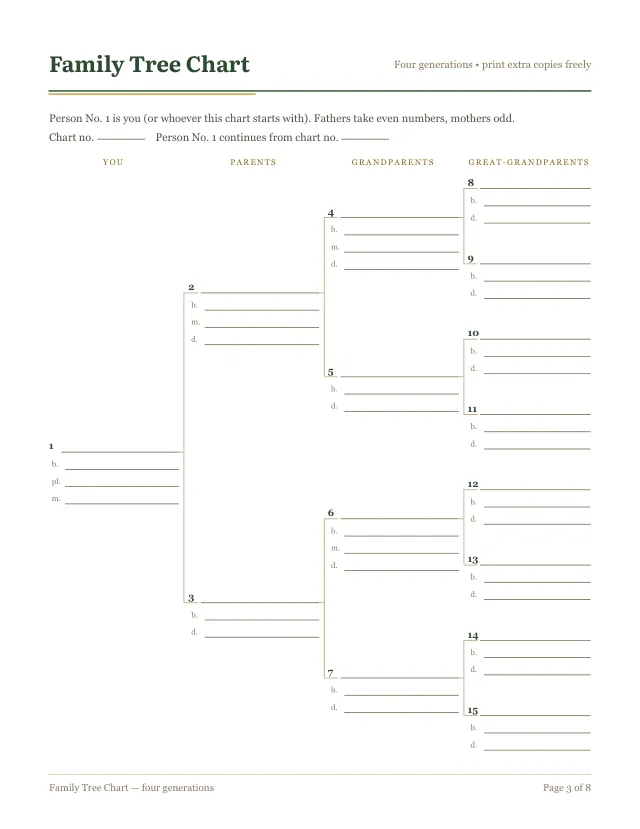
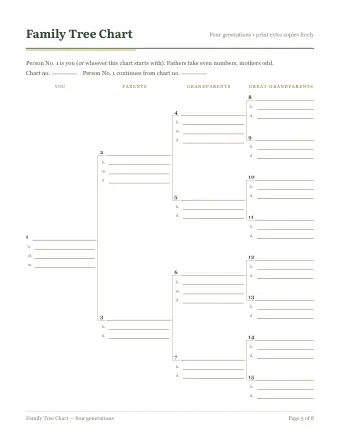 3. Family tree chartYou, parents, grandparents, great-grandparents — 15 people
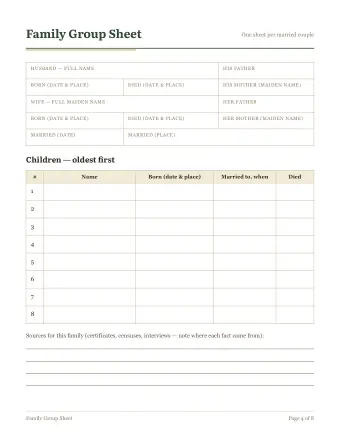 4. Family group sheetOne couple and up to eight children
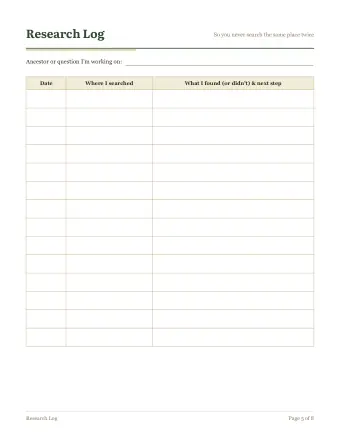 5. Research logSo you never search the same place twice
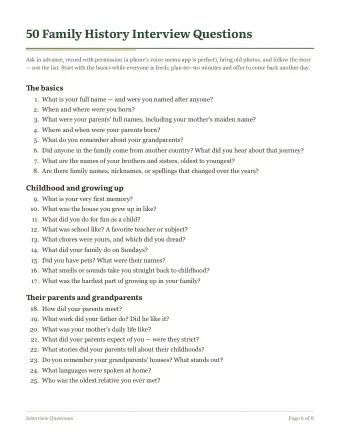 6. Interview questions 1–25Gentle questions for older relatives
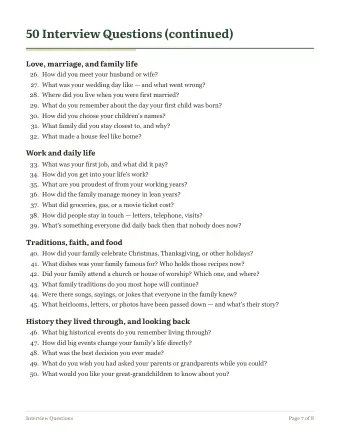 7. Interview questions 26–50Love, work, traditions, history
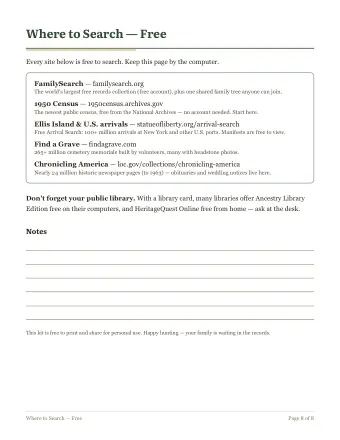 8. Where to search — freeFive free sites to start with, plus the library tip
How to fill in a family tree chart
Genealogists follow a few simple conventions. Use them from day one and your chart will make sense to any relative — or any library — years from now.
- Start with yourself as No. 1. Your father is No. 2 and your mother is No. 3. From there, every father’s number is double his child’s and every mother’s is double plus one — so your father’s father is 4 and your mother’s mother is 7.
- Write women under their maiden names — the surname they were born with. It’s the key to finding their parents.
- Write dates as day, month, year: 12 Mar 1891. It avoids the 3/12-or-12/3 confusion and is how most family historians record dates.
- Write places from small to large: town, county, state — and country for immigrants. For example: Springfield, Sangamon County, Illinois.
- Use pencil and mark your guesses. Write “abt. 1890” for an estimate and a question mark for a doubt. Blanks aren’t failures; they’re your to-do list.
When you reach your great-grandparents (Nos. 8–15), start a fresh chart for each of them. Give the new chart a number in the “Chart no.” blank, and note which person it continues from — that’s what the two blanks at the top are for.
Printable or fillable — which one should I download?
| Printable PDF | Fillable PDF | |
|---|---|---|
| Best for | Writing by hand, in pencil | Typing on your computer |
| How to use it | Print, then fill in at the kitchen table | Open in Edge, Chrome or Adobe Reader, click a line, type, save (Ctrl+S) |
| Pages | The same 8 pages | The same 8 pages, plus checkboxes you can tick |
Helping a grandchild with a school family tree project?
School family tree projects usually ask for a few generations — the student, parents and grandparents. Page 3 covers that and one generation more. Print an extra chart, fill in what you know together at the kitchen table or over a video call, and let them interview you with a few questions from pages 6 and 7. That conversation is usually the part they remember.
Filled it in? Your next free steps
- Find your family in the 1950 census — free, no account needed. Our beginner’s guide walks you through it.
- Interview your oldest relative while you can. Here are 50 family history interview questions, with tips on recording the answers.
- Search the free databases. Our list of the best free genealogy sites covers census, immigration, military and cemetery records.
- Visit the graves. Learn how to use Find a Grave to find headstones, dates and relatives.
Frequently asked questions
Is this family tree chart really free?
Yes. The whole 8-page kit is free to download, print and share for personal use. There’s no email form, no account and no payment — the download starts as soon as you click.
Can I fill in the family tree chart on my computer?
Yes. Download the fillable version, open it in Microsoft Edge, Chrome or Adobe Reader, click any line and type. Save with Ctrl+S, then print whenever you like. The regular version is made for writing by hand.
What size is the printable family tree chart?
Every page is standard US Letter (8.5 × 11 inches) and designed to print well in black and white on any home printer. Print as many copies of the chart as you need.
How many generations does the chart hold?
Four: you, your parents, your four grandparents and your eight great-grandparents — 15 people in all. To go further back, start a new chart for each great-grandparent and use the “Chart no.” blanks to link them.
What do the numbers on a family tree chart mean?
You are No. 1. A father’s number is always double his child’s, and a mother’s is double plus one: your parents are 2 and 3, your grandparents 4 to 7, and your great-grandparents 8 to 15. Genealogists call this ahnentafel numbering.
Sources
- Charts and Forms — National Archives
- Start Your Genealogy Research — National Archives
- How to Build a Family Tree: Tracing Your Ancestors — National Genealogical Society
- Free Charts and Templates — National Genealogical Society
- 1950 Census website — National Archives
Facts checked against these sources on October 9, 2026.
Keep going: Start your family tree for free • 50 interview questions • Sort the old photo box • The best free genealogy sites